
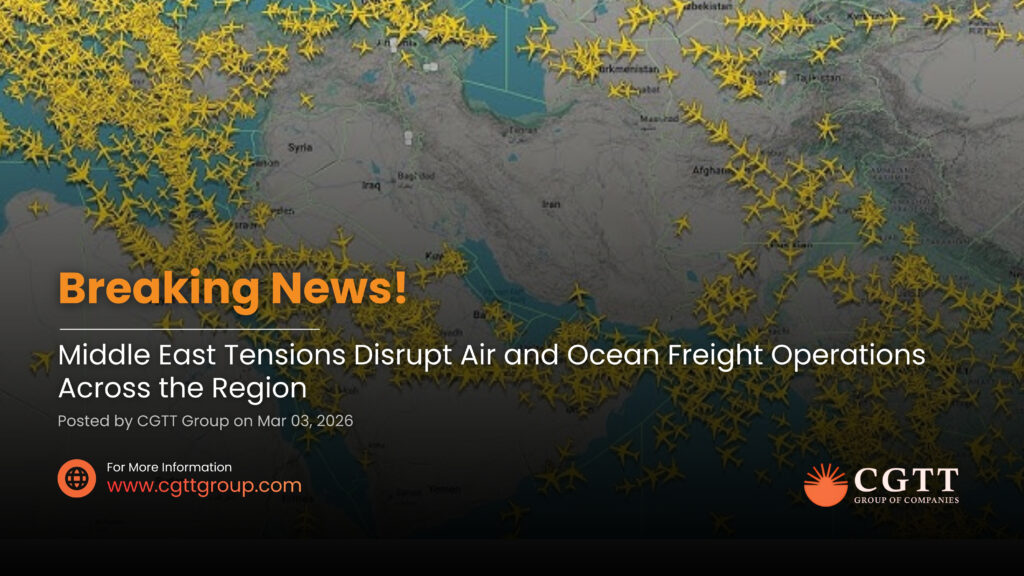
Middle East Tensions Disrupt Air and Ocean Freight Operations Across the Region
On Saturday, February 28, renewed military activity across the Middle East triggered widespread disruption to global supply chains, significantly affecting both air and ocean freight movements.
Air Freight Update
Escalating tensions have led to extensive airspace closures throughout the region, resulting in flight cancellations, route suspensions and major operational challenges. Key transit hubs such as Dubai and Doha have been particularly impacted.
Countries with Full Airspace Closures:
- Iran – Airspace completely closed.
- Iraq – All flights suspended; airspace closed.
- Israel – Closed to civilian aviation.
- Qatar – Civilian air traffic suspended.
- Bahrain – Closed as a precautionary measure.
- Kuwait – Closed until further notice.
- Syria – All flights suspended.
Countries with Partial Closures or Significant Restrictions:
- United Arab Emirates (UAE) – Operating under a temporary and partial airspace closure. Major airports including Dubai (DXB), Al Maktoum (DWC) and Abu Dhabi (AUH) have suspended commercial flight operations despite limited technical airspace availability.
- Jordan – Limited operations with intermittent full temporary shutdowns.
- Lebanon – Airspace remains open; however, flight activity is minimal with elevated security advisories.
- Oman – Implemented significant restrictions following retaliatory missile developments.
Aircraft already en route during the escalation were diverted to alternative destinations, including Egypt and Turkey. In addition, more than 15 airlines have temporarily suspended selected Middle East services through at least Sunday.
Ocean Freight Update
The situation has also severely impacted maritime trade flows.
Iran’s Revolutionary Guard Corps (IRGC) announced the closure of the Strait of Hormuz, one of the most strategically important shipping lanes globally—particularly for oil exports from the Middle East.
Reports indicate vessels received VHF communications stating that passage through the Strait of Hormuz is currently not permitted. This development has significantly increased operational risk and uncertainty.
The Strait serves as the primary maritime gateway to and from the Persian Gulf, including key ports in the UAE, Bahrain, Qatar, Kuwait, Iraq, and Dammam in Saudi Arabia. At present:
- Vessels inside the Gulf are unable to exit.
- Incoming vessels cannot enter.
- Carriers have begun announcing service suspensions and rerouting measures (including official advisories from major global shipping lines).
Ongoing Developments
The situation remains highly dynamic and subject to rapid changes. We are closely monitoring developments and assessing potential impacts on cargo movements.
Customers affected by these disruptions will be contacted directly by their account managers to ensure continuity planning and alternative routing solutions.
For the latest updates regarding your shipment status or alternative routing options, please reach out to your local CGTT representative.
